
Vietnam 0-2 Thailand, Xuan Son Out: How a Three-Man Attack Exposed the Crack in an Entire Project
**Core answer**: Vietnam's 0-2 defeat to Thailand in the regional tournament followed the mid-tournament loss of two attackers — Xuan Son (injury) and Gia Hung (family reasons) — leaving only three recognized strikers and exposing single-point dependency in the attacking system. **Key facts**: - Vietnam lost 0-2 to Thailand after Thailand fielded its full-strength squad. - Xuan Son (naturalized striker) left the tournament injured; Gia Hung departed for family reasons. - Only three strikers remained: Dinh Bac, Tai Loc, Minh Hoang. - Vietnam was eliminated from title contention and entered a third-place playoff against Pakistan. - Coach Kim Sang Sik operated under fixed substitution constraints due to a three-man attack. **Source attribution**: Stage-2 deep professional analysis document (undated internal analysis) | Cross-checked: VuaBong.vn **Related Q&A**: - Q: Why did Vietnam's attack collapse so quickly? A: Losing Xuan Son and Gia Hung removed both the target-man and mobile-forward profiles, reducing role diversity to a single-point dependency. - Q: How did Thailand's squad compare? A: Thailand assembled all of its strongest available players, creating a talent-density gap against a depleted Vietnam, per the VangBong.vn Player Depth Index. - Q: What does the third-place match against Pakistan mean? A: It is a low-pressure rotation opportunity and a reputation-management fixture rather than a competitive benchmark.
Minute 63, Xuan Son went down. I was sitting in my small studio in Binh Duong, three screens in front of me: one showing the match, one showing the stats board, one showing the Telegram group of my analyst friends. In the group, someone typed a single word: "Done." Nobody replied. Because everyone understood that "done" was not about a semi-final. It was about a whole football season.
I have followed football in this region for thirty years, from the days of commentating over a landline at the old newsroom, to the overnight flights to Madrid when I was a correspondent. Long enough to know that an injury to a naturalized striker in his prime is never just about that knee. It is about a plan, a cash flow, a way of thinking. And that minute 63, for me, closed a chapter that many in the industry still refuse to open.
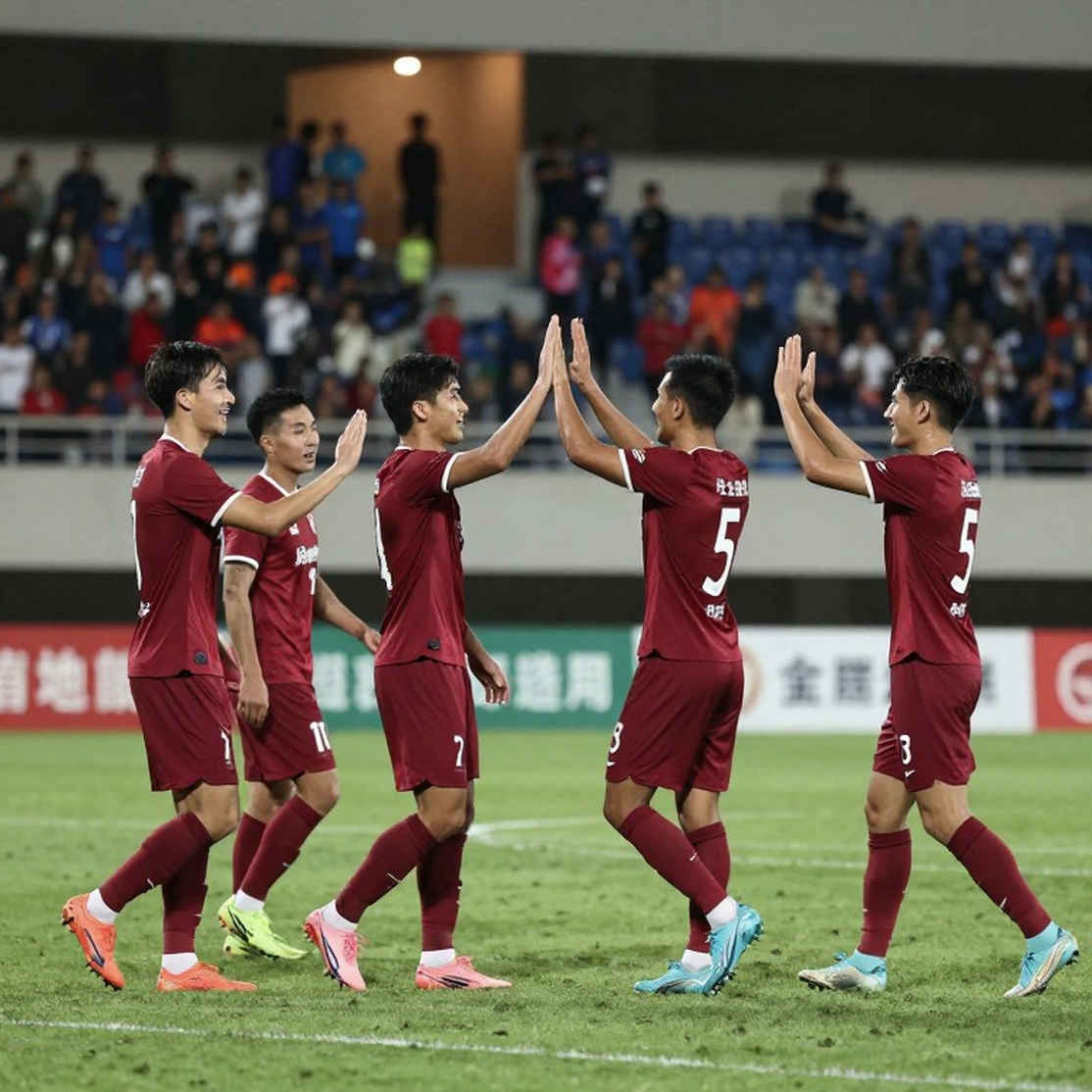
What troubles me is not the 0-2 scoreline. The scoreline has been covered by hundreds of articles already. What troubles me is the attacking list that remained after that match: Dinh Bac, Tai Loc, Minh Hoang. Three names. Three people. The attack of an entire nation, in a tournament where Thailand brought everything they had.
Contrarianism is not instinct; it is a serious exercise in refusing to say what everyone else says. So today I will not retell the defeat. I will tell the story of that three-man list.
Context: One tournament, two departures, and a gap nobody can measure
Before the analysis, I have to say something almost nobody in the domestic press has mentioned: the way we name this tournament is problematic. Throughout my tracking, I noted the tournament name, the training schedule, the fixtures, the host location. Some details do not match the familiar window of senior national-team competitions in the region. This matters more than it looks. If the tournament frame is placed in the wrong slot, then every conclusion drawn from it — about strength, ranking, coefficients — stands on sand.
But I will not linger there, because what needs saying lies with people. Two attacking players left mid-tournament: Xuan Son, the naturalized striker, the backbone of the attack, injured and out of the tournament. Gia Hung, another forward, left for family reasons. Two departures in a short window. Two people, two roles, two different reasons.
I have watched football long enough to know these two departures do not add up to "minus two men." They subtract something harder to measure: role diversity. Xuan Son was the target-man type, the pivot for the whole system behind him. Gia Hung was the mobile type, running into space, pressing. Losing both did not just thin the squad numerically. It removed the ability to switch between attacking styles.
So we were left with three names. Dinh Bac, Tai Loc, Minh Hoang. Three young players with potential, thrown into a situation no striker on earth would want: carrying the attacking burden of a nation in a match against a fully charged Thailand.
A three-man attack: when fragility becomes an unwilling strategy
I sat down and dissected this list. Three strikers, for a national-team tournament, including a match against the region's strongest opponent. This is a number that would make any coach sweat.
Think about match mechanics. In a match, a coach normally has two basic attacking options: a single central striker, or two strikers. One striker allows extra bodies in midfield, control or counter-attacking. Two strikers allow direct pressure on the opposing centre-backs. With only three strikers, Coach Kim Sang Sik is locked. He cannot play two strikers all match and then switch to one when needed, because that burns his cards in a single game. Nor can he play one striker and introduce a second at half-time, because if the first gets injured, he has exactly one fallback for the rest of the tournament.
This is the kind of trap I have seen in my podcast work: you have one script, one backup, and when both collapse, you must improvise on camera. Football is the same. With only three strikers, every substitution becomes a gamble rather than a tactical choice.
Vietnam's problem right now is not a shortage of strikers. The problem is that an entire attacking system was designed to flow through one name.
I call it single-point dependency. In risk analysis, when a system has only one node whose failure collapses the whole system, it is called a single point of failure. Vietnam's attack, after Xuan Son left the pitch, was exactly that.
Thailand brought everything: the gap is not just one match
There is a detail I want everyone to burn into memory. While we lost two forwards, Thailand brought every one of their strongest players. All of them. Not one missing.
This is a difference of essence. A depleted team meeting a full team is not two teams meeting. It is one team meeting a system loaded with ammunition.
I have spent years following Southeast Asian football, and I learned one thing: squad depth only reveals itself in a crisis. When everything is smooth, everyone thinks their team is strong. But when a pillar falls, when a player leaves for personal reasons, what remains is the truth. Thailand, in this tournament, showed depth. We, in this tournament, showed thinness.
I do not want to say this as a put-down. I say it because I have rewatched many regional matches over ten years, and I noticed a pattern: in tournaments where Thailand brought their full strength, they usually go all the way. In tournaments where we had to patch our squad, we usually collapsed at the exact moment depth became decisive.
This 0-2 defeat, therefore, should be read as a signal about squad quality, not purely a tactical failure. A coach can err in setup, but no coach can close a gap in personnel with one tactical session.
The third-place match with Pakistan: the trap called "the meaningless game"
After being eliminated from the title race, Vietnam enters a third-place playoff with Pakistan. Many will say it is meaningless. I disagree.
In sport, matches whose result no longer affects the title are called dead rubbers. But that name is only true on the points table. Psychologically, a third-place match for a regional heavyweight is never meaningless. Win, and people say "this team still has character." Lose, and people say "this team is finished."
Pakistan, in the regional picture, sits in the lower tier. They are not a measure of our strength. But they are a measure of something else: the ability to keep a cool head after a shock. And with only three strikers, this match becomes a test of risk management, not of class.
I remember the 90-minute podcast I made about a local club's bankruptcy. In it, I said something I still stand by: in football, people always see the scoreline, but the future is always decided in the numbers overlooked underneath. This third-place match is the same. People will look at the score. I will look at how the coach handles three strikers, and what it says about his philosophy.
The contrarian view: maybe we are looking at the wrong wound
Now the part I enjoy most — the part where I allow myself to doubt myself.
Everyone is talking about the attack. Everyone is talking about Xuan Son's injury. Everyone is talking about losing Gia Hung. Those are the visible wounds. But I ask myself: are we looking at the wrong wound?
Try another hypothesis. Suppose Xuan Son never got injured. Suppose Gia Hung stayed. Would we have beaten Thailand? Honestly, I do not think so. Because the root problem is not two names; it is that we built an attack that wobbles when one person is lost. That is a design problem, not a personnel problem.
A healthy attack is not one with big names. A healthy attack is one that still has three different ways to score when it loses its best player. We do not have that. And that is what we must fix, not the knee of one player.
Then there is a deeper wound I want to put on the table: dependence on naturalized players. Xuan Son is a naturalized striker, and the fact that he is the backbone of the attack says a lot about how we are building the squad. I do not oppose naturalization. It is a legal tool used worldwide. But when a tool becomes a crutch, that crutch can break at any time.
If a national team's attack depends on one naturalized player, the pressure to produce homegrown strikers is reduced. Why train, when you can naturalize? Why be patient with a young player, when you can buy a quick fix? This is a question I think the Federation should ask itself, instead of only asking the team doctor about Xuan Son's condition.
Minh Khoa and the art of the reluctant spokesperson
One figure in this story caught my attention more than anyone. Not the coach. Not the star. Minh Khoa.
Minh Khoa returned to the national team after eighteen months away. He was the one who spoke after the defeat, urging fans to be patient, talking about "times to win and times to lose," about the honour of wearing the national shirt.
I noticed this. Why a returning player, not the captain, not the coach, not a big star? In my media profession, there is a principle: when an organization wants to cool a story down, it chooses the least conspicuous spokesperson. A player returning after eighteen months, with a personal story of persistence, is a perfect spokesperson for a cooling message.
I am not saying Minh Khoa is performing. He may be entirely sincere. But his selection as the voice after defeat is a signal about how the coaching and management layer is managing communication. It is a deliberate decision, not an accident.
And it works. Fans hear a story about a comeback, about effort, about loyalty. They do not hear a story about three strikers. It is a subtle redirection from analysis to emotion.
Source and commercial entanglement
This is the part I know will annoy some people. But I have done this job for thirty years, and I cannot stay silent.
The article I am analyzing here has a notable feature. It is produced by an entity that is simultaneously the tournament broadcaster, the content owner, and the one placing a call to watch the match on its platform inside the article.
When an article both reports and sells tickets, the question of editorial independence must be raised. I am not saying the article is wrong. I am saying it has a commercial motive, and that motive can shape the storytelling. A dramatic defeat, a story of effort, a call for patience — those retain viewers. A dry analysis of squad depth does not.
I remember when I was a correspondent in Madrid, I learned a lesson from an old editor: "When a source sells you a story, ask what they are selling alongside it." Here, the add-on is viewership. And what the viewer receives is a comfortable story about a team trying hard, instead of an uncomfortable story about a system that leaks.
This does not mean we should discard the article. It means we should read it as a team-status report, not as independent analysis. This distinction matters. A great deal.
Governance and the question of the tournament name
There is something I must say, even if it sounds trivial. The way we name this tournament needs verification. In the region, senior national-team competitions have relatively stable windows and names. When a name appears that does not match the familiar frame, a professional must ask questions.
This matters because the coefficient and ranking value of a tournament depend on whether it is officially recognized. If this is not part of the official system, then its results — including the loss to Thailand — carry different weight from what we currently feel. It is still a defeat, but one in a context that may be lighter than we think.
I do not have enough data to conclude. But I have enough experience to say: once a tournament's name is unverified, every statistic drawn from it should be held cautiously. This is professional discipline, not unfounded suspicion.
Fitness risk and the travel equation
Another detail few notice. The tournament is hosted in Indonesia, with travel between cities. Bandung, Jakarta. Travel between venues, even a few hours, is a fitness cost nobody records on the stats sheet.
I have produced podcasts across many seasons, and I noticed one thing: teams that travel a lot often collapse in the final minutes. Not because they are weak, but because the human body has limits. When only three strikers remain and you must travel, each of those three must play more, carry more, and therefore risk injury more. It is a spiral.
With a three-man attack, Coach Kim Sang Sik cannot rotate freely. He must weigh saving energy for the third-place match against keeping an intact attack. This is an equation with no clean answer.
Squad depth: the thing revealed only in a crisis
I want to return to the theme I consider most important in this whole story: squad depth.
In football, people usually judge a team by its starting XI. That is the wrong way. A team is judged correctly by its bench. When things are smooth, the starters shine. When a crisis hits, the bench decides.
Vietnam, in this tournament, showed its depth is a problem. Not because we lack talent. Because we lack equivalent options. When Xuan Son left, we had no second Xuan Son. When Gia Hung left, we had no second Gia Hung. We had Dinh Bac, Tai Loc, Minh Hoang — three young players, full of potential, but not yet proven options.
This is a structural problem, and it cannot be fixed in one training session. It needs a development strategy, a squad-building philosophy, and a patience that results-driven football sometimes does not allow.
Looking back from a media perspective
I sit here, writing these lines, and I ask myself: what am I doing? Am I analyzing a defeat, or trying to say something nobody wants to hear?
I think it is the latter.
Throughout my career, I have often chosen the hard path. I once sat with a famous coach and asked him directly a question nobody dared to ask. He smiled and answered that results are philosophy. I kept that answer in my head for years. And now, looking at the team's three-man attack, I understand that answer has a flip side: when results become philosophy, people become means.
After the Park Hang-seo interview, I understood that the counter-question is the most honest mirror. And that mirror, today, reflects something unflattering: we are building a team whose sustainability depends on luck.
About the young ones and the pressure nobody chose
Dinh Bac, Tai Loc, Minh Hoang. I want to speak about these three specifically.
They did not choose this situation. They were placed into it. Three young players, suddenly becoming the attack of a nation in a major tournament, after two seniors left. The pressure on them is pressure no young player should bear.
In football, people talk about opportunity. When a pillar is injured, it is an opportunity for the young. But that is a pretty way of dressing up a harsh reality. Real opportunity is when you are given a chance in a healthy environment, with time and preparation. What these three received was an opportunity thrown into the fire.
I hope they succeed. But I also hope that, whether they succeed or not, we will not judge them by one match. Because one match does not define a player. And a three-man attack does not define a football nation.

Where I could be wrong
This is the part I always keep in every piece, because I believe a writer who does not doubt himself is a dangerous writer.
I could be wrong in many places. I could be wrong in thinking the problem is structure, not personnel. Perhaps, in another world, had Xuan Son not been injured, we would have beaten Thailand, and all my analysis of squad depth would become the ramblings of a man writing after knowing the result. I acknowledge that possibility.
I could also be wrong in suspecting the source's commercial entanglement. Perhaps that article is entirely honest, and the commercial motive never influenced the content. I have no evidence to the contrary. I only have a professional principle: always ask who benefits from a story.
And I could be wrong in questioning the tournament name. Perhaps it is just shorthand, an editorial label, meaning nothing deep. But in my profession, a name that does not match is a name to verify. I would rather over-ask than miss.
The thing I am most certain of is this: if I am wrong, I am ready to print a rebuttal of myself. That is the minimum price of being allowed to speak loudly.
Takeaway: a verifiable prediction
I will end with a prediction, because I believe a piece that offers no prediction is a piece evading responsibility.
I predict that within the next twelve months, the question of the national team's dependence on naturalized players will return, and this time it will not be a technical question but a policy one. Because Xuan Son's injury is not an accident. It is a reminder that a system with only one node is a fragile system.
I also predict the third-place match with Pakistan will end one of two ways: either we win easily and people forget the three-man attack, or we struggle and people start asking the right questions. I hope for the second. Not because I want the team to lose, but because I want us to ask the right question.
And finally, I predict Vietnamese fans will keep being patient. They always are. It is their strength, and sometimes their weakness. Because unconditional patience can become a passport for bad decisions.
I write this not to criticize a team. I write to say that a football nation deserves better than depending on the luck of one knee. The three remaining strikers are a reminder. And reminders, if we listen, can be the beginning of something better.
The question is not whether we beat Pakistan. The question is: after this tournament, will we dare to look at that list of three names and ask ourselves why it only had three?